
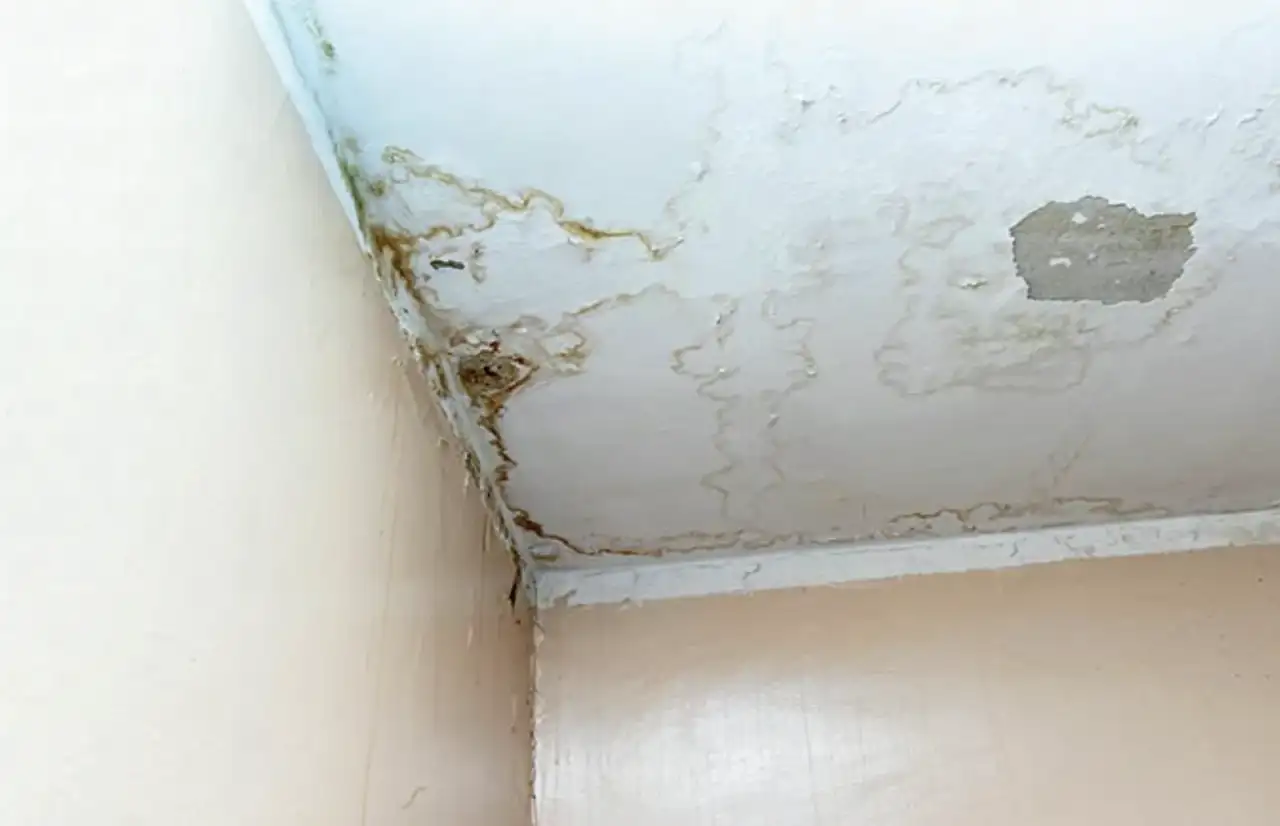
Signs you need this
- • A brown or yellow-edged stain spreading across a ceiling, often under a bathroom, roof valley, or a unit above them in a three-decker
- • Drywall or plaster that feels soft, spongy, or bulges when pressed near a stain or below a window
- • A musty smell in a room, closet, or basement stairwell that was not there before
- • Paint bubbling, peeling, or a seam splitting open along a wall or ceiling joint after a storm or a hard freeze
Worcester Drywall & Plaster treats water damage drywall repair as two different jobs depending on how the water arrived. An active leak, a burst pipe, or a ceiling that is still sagging and saturated is same-day work: wet gypsum loses structural integrity fast and keeps feeding mold behind the surface for as long as it stays wet. A stain from a leak that has already been fixed, or a section that dried out months ago, is scheduled work: it still needs to be cut open and checked, but it will not collapse tonight.
This comes up most often for homeowners in Elm Park, Crown Hill, Montvale, and the West Side with 1870-1925 lath-and-plaster ceilings damaged by an ice dam backing water up under the roof edge, for landlords and property managers with three-decker units in Vernon Hill, Grafton Hill, Main South, Green Island, and Union Hill turning over an occupied unit fast after a burst pipe or a tub overflow, for homeowners filing a homeowner’s insurance claim who need a documented repair scope, for owners of homes with damp basements near the Blackstone River headwaters seeing recurring staining or soft drywall at the sill line, and for anyone with a slow, hidden leak (roof flashing, a failed shower pan, an ice dam) who has watched a stain grow over weeks and finally wants it opened up and fixed correctly.
Worcester Drywall & Plaster diagnoses how far water traveled behind a wall or ceiling, removes only the material that cannot be saved, dries and verifies the cavity, then rebuilds the surface to match the surrounding wall or ceiling. On a Victorian home this often means matching new drywall into existing plaster; on a three-decker unit it usually means a straightforward gypsum board cut-and-patch. The work is not just patching a stain. It is confirming the framing and insulation behind the surface are dry before anything gets closed back up, so the same spot does not reopen or grow mold six months later.
How Worcester Drywall & Plaster Diagnoses and Repairs Water-Damaged Drywall
Water damage drywall repair is not really about the stain a customer sees. It is about everything the water touched on its way to that stain. Water moves along the path of least resistance, following a joist bay, running down a stud cavity, or wicking sideways along the back of a piece of gypsum board before it ever shows up as a visible mark. A six-inch brown ring on a ceiling can sit above two or three feet of wet insulation and a soaked joist. Worcester Drywall & Plaster starts every water damage job by tracing that path, not by patching what is visible.
Moisture Diagnosis Before Any Cutting
The first step on every job is a moisture meter reading, not a visual guess. Gypsum board and wood framing hold water in ways that are not always obvious from the surface, and cutting into a wall before confirming the extent of saturation risks missing wet material that keeps feeding mold behind a fresh patch. Worcester Drywall & Plaster maps the wet area with the meter, marks where sound, dry board begins, and only then cuts back to that line, usually with a margin of a few extra inches into confirmed-dry material. Cutting back to sound board, rather than just patching the visible stain, is the difference between a repair that lasts and one that reopens by spring.
Ice Dams and Burst Pipes: Worcester’s Two Recurring Failure Modes
Worcester sits at 480 to 620 feet of elevation and gets a real New England winter, which drives two patterns of water damage more than anything else. Ice dams form when heat escaping through an under-insulated attic melts snow on the upper roof, which refreezes at the cold eave and backs up under the shingles, sending meltwater into the ceiling below. This shows up as a slow, recurring stain near an exterior wall or a roofline, often reappearing every winter until the underlying ice dam and insulation issue is addressed alongside the drywall repair. The second pattern is a burst pipe during a hard freeze, usually in an exterior wall, an unheated three-decker stairwell, or a vacant unit where heat was allowed to drop too low. This is sudden and often severe, soaking a ceiling or wall cavity all at once and requiring same-day response before the saturated gypsum sags or fails.
Plaster Versus Drywall: Why the Building Era Changes the Repair
Worcester’s building stock splits sharply by era, and that changes how a water damage repair gets handled. The city has roughly 6,000 wood-frame two and three-family houses built between 1880 and 1920, concentrated in Vernon Hill, Grafton Hill, Main South, Green Island, and Union Hill, most of which were re-plumbed and partially updated with drywall over the decades. These units typically have straightforward gypsum board ceilings and walls, so a water damage repair is a cut-and-patch job: remove the wet section, replace with new board matched to the existing Type X or standard board, tape, and finish.
The Victorian districts, Elm Park, Crown Hill, Montvale, and the affluent West Side, are a different story. Homes built between 1870 and 1925 in these neighborhoods often retain original lath-and-plaster ceilings and walls. Plaster does not fail the same way drywall does. It can absorb water and survive if caught early, but prolonged saturation causes the plaster keys, the small wedges of material that grip the wood lath behind it, to break down, and the whole ceiling section can sag or drop. Repairing water-damaged plaster means deciding, case by case, whether to patch the existing plaster in place or cut it out and blend in new drywall with a skim coat of joint compound feathered out far enough that the transition disappears under paint. Worcester Drywall & Plaster makes that call after inspection, not before, since a plaster ceiling that looks ruined sometimes just needs the wet lath re-secured and the surface skim-coated, while one that looks stable can be structurally compromised behind the surface.
Drying and Verifying Before Closing the Wall
Once damaged material is removed, the cavity has to actually dry before it gets closed back up. Framing that is closed up while still holding moisture becomes a mold source no matter how good the drywall finish looks on the surface. Worcester Drywall & Plaster re-checks the exposed framing with the moisture meter and waits until it reads down to roughly 16 percent moisture content or below before installing new insulation and board. In Worcester’s colder months, drying takes longer, and the schedule reflects that rather than rushing a wall closed on a fixed timeline. Purple mold-resistant board, sometimes marketed as M2Tech, gets used in areas prone to recurring moisture exposure, such as basement walls near the Blackstone River headwaters where several Worcester properties see chronic dampness even without a single dramatic leak event.
Documenting the Repair for Insurance
A large share of water damage drywall work in Worcester runs through a homeowner’s insurance claim, and the repair has to hold up to that process. Worcester Drywall & Plaster photographs the damage before demolition, documents the cut-back area and any framing or insulation replacement, and writes a scope that lines up with the categories an adjuster’s estimate typically covers. Work performed under a Massachusetts Home Improvement Contractor registration and Construction Supervisor License, both required under 780 CMR for this scope of work, gives the paperwork the standing an insurer expects to see. On any property built before 1978, which covers most of Worcester’s Victorian and three-decker stock, EPA RRP lead-safe work practices apply whenever the repair disturbs painted surfaces, and Worcester Drywall & Plaster works as an EPA RRP Lead-Safe Certified Firm to keep the job compliant.
Occupied Three-Decker Repairs
A three-decker unit turnover after a burst pipe or an upstairs tub overflow adds a constraint that a single-family home repair does not have: a tenant living in or waiting to move back into the unit, and a landlord losing rent every day it sits unfinished. Worcester Drywall & Plaster schedules these jobs to move fast once the water source is confirmed stopped, using dust containment to keep the rest of an occupied unit livable during the cut-out and rebuild, and prioritizing texture and finish match so the ceiling does not read as an obvious patch job to the next tenant walking through.
Related Work
Water damage repair often starts after another trade’s fix. Roof leak repair, plumbing repair, or ice dam removal stops the water source before Worcester Drywall & Plaster rebuilds the surface. Once the repair is finished, interior painting blends the patched area into the rest of the room. On the same visit, Worcester Drywall & Plaster commonly handles unrelated drywall cracks or holes found during the inspection, and replaces wet insulation when it turns up behind the wall or ceiling.
Materials & standards
Products & materials we use
- USG Sheetrock
- National Gypsum Gold Bond
- National Gypsum Gold Bond XP
- CertainTeed
- DensArmor
- Purple mold-resistant board (M2Tech)
- FibaTape
- RedGard
Standards & codes we work to
- 780 CMR (Massachusetts State Building Code, IBC/IRC-based)
- ASTM C1396
- GA-214 finish Levels 0-5
- UL fire-rated assemblies
- ICRA (Infection Control Risk Assessment)
- EPA RRP lead-safe work practices for pre-1978 housing
- Massachusetts Construction Supervisor License (CSL)
- Massachusetts Home Improvement Contractor (HIC) registration
- EPA RRP Lead-Safe Certified Firm
What the terms mean
- Cut back to sound board
- Moisture-meter diagnosis
- Drying and verifying a cavity below roughly 16 percent moisture content
- Level 4 and Level 5 finish match
- Type X fire-rated board
- Setting-type versus pre-mixed joint compound
- Dust containment
- Three-decker unit-turnover repair
Options & variants
| Option | When it applies | Cost |
|---|---|---|
| Spot patch and finish match | Small, contained stain with no soft board, framing dry | Lowest cost, fastest turnaround |
| Cut-back and section replacement | Water traveled along a joist bay or stud cavity; some board is soft or delaminated | Moderate, driven by how much board is cut out |
| Full ceiling or wall replacement | Widespread sagging, saturation across multiple sheets, or a collapsed section | Highest cost, includes new insulation if affected |
| Plaster-to-drywall transition repair | Lath-and-plaster ceiling damaged beyond patchable; blended into drywall with a skim coat | Higher labor cost for the finish blend, common in West Side and Elm Park homes |
| Insurance-documented repair | Any of the above, scoped and photographed to match an adjuster's estimate | Priced to the approved scope, not open-ended |
What affects cost
- • How far the water traveled before it was caught. Water follows joists and studs, so a small ceiling stain can hide a much larger wet area behind it
- • Whether the surface is drywall or original lath-and-plaster, since plaster repair and blending takes more skill and time than a gypsum board patch
- • Access. A ceiling repair in a finished, occupied three-decker unit costs more in labor than an open basement wall
- • Texture and finish match. A smooth Level 5 ceiling or a heavy texture takes longer to blend invisibly than a flat unfinished wall
- • Whether insulation, framing, or subfloor also needs replacement, not just the drywall or plaster surface
- • Whether the job needs to happen fast to keep a rental unit occupied, which can affect scheduling, though Worcester Drywall & Plaster prices the scope, not the rush
What to expect
- 1
Inspect and map moisture
Worcester Drywall & Plaster inspects the affected ceiling or wall and uses a moisture meter to map how far the water traveled beyond the visible stain.
- 2
Confirm the source is stopped
Any active source of water gets addressed or confirmed stopped before repair work starts, since patching over an active leak wastes the customer's money.
- 3
Cut back to sound material
Worcester Drywall & Plaster cuts back to sound, dry board or plaster, removing only what is compromised, and opens the cavity to check framing and insulation.
- 4
Dry and re-verify
The exposed area is left to dry and gets re-checked with the moisture meter until the wood framing reads below roughly 16 percent moisture content before anything is closed up.
- 5
Rebuild and finish
New drywall or blended plaster goes in, taped, finished to match the surrounding texture and sheen, and for insurance jobs, documented with before and after photos tied to the adjuster's scope.
When this isn’t the right call
- If the water source is still active and unresolved (a leaking roof, an ongoing plumbing failure), the priority is a roofer or plumber first, then Worcester Drywall & Plaster handles the drywall rebuild.
- If mold has spread well beyond the drywall into a large area or the HVAC system, that calls for a dedicated mold remediation contractor before drywall repair begins.
- If the damage is a small nail pop or a settling crack with no water involved, that is standard drywall repair, not a water damage job.
- If the entire home's plaster system is failing from age rather than a specific water event, that is a broader plaster restoration conversation, not a single-spot water repair.
Frequently asked questions
How do I know if my ceiling stain is still wet or just an old mark? +
Press gently on the stained area. If it feels soft, spongy, or your finger leaves an indent, the board is still wet or damaged. Worcester Drywall & Plaster uses a moisture meter to confirm either way rather than guessing from the stain color alone.
Will you work with my homeowner's insurance claim? +
Yes. Worcester Drywall & Plaster documents the damage with photos and a written scope that can match an adjuster's estimate, and can coordinate the repair timeline around the claims process.
Do you repair plaster ceilings or only drywall? +
Both. Many Worcester homes in Elm Park, Crown Hill, and the West Side still have original 1870-1925 lath-and-plaster ceilings. Worcester Drywall & Plaster repairs plaster directly or blends a drywall patch into surrounding plaster with a skim coat so the transition is not visible.
My tenant's ceiling is soaked from a burst pipe. How fast can you get to a three-decker unit? +
Active leaks and sagging ceilings are treated as same-day priority, especially in occupied rental units where a landlord needs the unit turned over. Worcester Drywall & Plaster inspects first to confirm the source is stopped, then moves straight into cut-back and dry-out.
Can you just paint over the stain instead of cutting into the wall? +
Painting over a water stain without opening the wall risks trapping moisture and mold behind the surface. Worcester Drywall & Plaster always checks with a moisture meter first. If the board is confirmed fully dry and the stain is old, a stain-blocking primer and repaint can be enough, but that call comes after inspection, not before.
How long does the drywall need to dry before you can close it back up? +
It depends on how saturated the cavity was and the season. Worcester Drywall & Plaster does not work on a fixed schedule; the area gets re-checked with a moisture meter until the framing reads dry, typically in the range of a few days for a contained spot up to longer for a widespread saturation, especially in cold winter months when drying slows down.
Will the repaired ceiling match the rest of the room? +
Yes. Worcester Drywall & Plaster matches the existing texture, whether that's a smooth Level 4 or 5 finish or a heavier texture, and blends the new joint compound so the patch is not visible once painted.
What causes most of the water damage you see in Worcester? +
Ice dams backing meltwater up under roof shingles and into ceilings during Worcester's snowy winters, and burst pipes during hard freezes, are the two most common causes, along with basement dampness near the Blackstone River headwaters and failed plumbing in older three-decker units.